Colored contact lenses sit at the intersection of vision care, cosmetic choice, and global manufacturing. Their appearance may catch the eye first; comfort, optical quality, and consistent production matter just as much. Grand View Research valued the global contact lens market at USD 20.4 billion in 2023. It projected a 9.6% compound annual growth rate from 2024 to 2030. This figure covers contact lenses broadly, not colored products alone. That distinction matters.
For a practical supplier comparison, the “Top 10 Colored Contact Lens Suppliers Worldwide” should be read as a buying guide, not a definitive league table. Supplier scale, product range, manufacturing transparency, and documented quality systems can vary, and public information is not always easy to compare. FDA optometrist Bernard Lepri offers a useful reminder: “Contact lenses are medical devices that require a commitment to proper use and care by the patient.” The quote concerns contact lenses generally, but it applies to colored lenses too. A vivid iris pattern is only one part of the decision. Buyers should also check product specifications, fit options, care guidance, and the supplier’s ability to provide reliable documentation. Those details are less photogenic. They deserve attention. The suppliers featured here are assessed through available company and industry information; readers should verify current claims directly before making purchasing decisions.
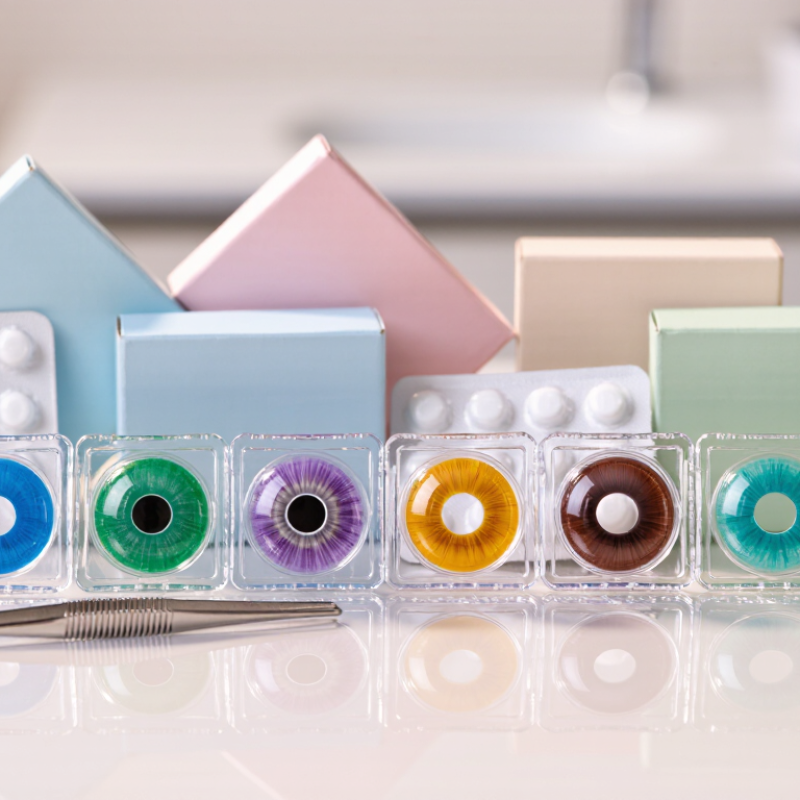
Colored contact lens suppliers help connect manufacturers, retailers, clinics, and consumers across international markets. Their role extends beyond moving products. They coordinate product specifications, packaging, quality records, and delivery schedules. A dependable supplier can provide clear information about lens materials, replacement periods, and available corrective powers. These details matter when buyers compare options across regions. The global market is diverse, and expectations can vary.
Suppliers also influence how consistently products reach their destination. Temperature and moisture controls, intact packaging, and traceable batch records support careful handling. Buyers should ask how product quality is checked and what documentation accompanies each shipment. Eye comfort and fit are individual, so suppliers should not replace guidance from a qualified eye-care professional. A polished catalogue is useful, but it cannot answer every practical question. That distinction deserves attention.
Tips: Request current specifications and sample packaging before placing a large order. Confirm that lens parameters match the intended market and customer needs. Ask about storage, shipping, and complaint procedures. Keep records. Even careful checks cannot remove every uncertainty, so review supplier claims critically.
Key Criteria for Comparing Worldwide Suppliers
Comparing worldwide colored-contact suppliers requires more than checking sample colors and unit prices. Ask for technical specifications covering lens material, water content, oxygen permeability, base curve, and diameter. Request traceability details, batch records, packaging specifications, and documented quality-control procedures. These details matter when a lens looks vivid in a catalog but fits or appears differently on the eye. Check whether color consistency is tested across production batches. Ask how defects and customer complaints are recorded. Small gaps in documentation deserve follow-up.
Safety evidence should carry real weight. The US Centers for Disease Control and Prevention reported nearly one million contact-lens-related outpatient and emergency visits annually, with estimated costs of $175 million. That estimate is US-specific, not a global supplier ranking. Still, it shows why reliable manufacturing and clear handling information matter. Check suppliers’ alignment with relevant standards, including the ISO 18369 series for contact lenses, and verify applicable market requirements independently. A certificate alone is not enough. Request its scope, issuing body, and current validity. Compare lead times, minimum order quantities, and shipping controls too; temperature and handling conditions can affect practical supply planning. One awkward but useful question: what happens when a batch fails inspection? A candid, documented answer is more informative than polished sales material.
Profiles of ten leading colored contact lens suppliers are most useful when they show how each business serves a different need. Some focus on high-volume daily lenses; others offer monthly wear, prescription ranges, or subtle color blending. Several supplier profiles may emphasize private-label development, while others stand out for custom shades, packaging support, or export capacity. These are practical distinctions, not proof of clinical quality. Fit still matters.
Compare each supplier’s material options, published wear schedule, manufacturing controls, and ability to provide consistent color across production batches. Ask for sample lenses and technical documents before judging a catalog image; screen colors can distort the shade. Grand View Research estimated the overall contact lens market at USD 20.4 billion in 2023 and projected a 6.5% compound annual growth rate from 2024 to 2030. That figure covers all contact lenses, not colored lenses alone, so it should not be presented as a colored-lens market estimate. A useful profile also notes what is not clear, such as limited public detail on batch-to-batch color variation. Supplier pages can look polished. Evidence may be thinner.
Top 10 Colored Contact Lens Suppliers Worldwide - Profiles of Ten Leading Colored Contact Lens Suppliers
Anonymous supplier profiles for market research and sourcing evaluation
| Profile | Supplier Type | Typical Product Scope | Common Customization Areas | Evidence to Request | Key Sourcing Consideration |
|---|---|---|---|---|---|
| 01 | Large-scale OEM manufacturer | Clear and colored soft contact lenses in daily, monthly, and other replacement schedules, subject to the manufacturer’s approved product range. | Lens color, graphic pattern, packaging format, private-label artwork, and selected lens parameters. | Current quality-management documentation; product specifications; applicable market authorizations; batch traceability records. | Confirm that the exact product and parameters are authorized for sale in the destination market. |
| 02 | ODM design-and-manufacturing supplier | Supplier-designed colored lens collections offered for customer branding and distribution. | Branding, packaging, collection selection, and permitted design variations. | Design ownership terms; approved labeling; product technical documentation; change-control procedures. | Clarify who owns the design and who is responsible for regulatory submissions and labeling. |
| 03 | Specialist colored-lens producer | Cosmetic and cosmetic-appearance lens designs, with availability depending on the producer’s authorized range. | Opaque or enhancing appearance, printed pattern, color selection, and graphic diameter. | Product specifications, including material, water content, dimensions, and replacement schedule; applicable safety and performance records. | Request samples and verify color appearance, fit-related parameters, and approved claims for each market. |
| 04 | Daily-disposable focused supplier | Single-use colored lens products where offered and authorized. | Color options, single-use packaging, and retail pack configuration. | Packaging integrity data, shelf-life support, batch records, and destination-market labeling. | Check shelf life, storage conditions, and whether the intended sales channel requires specific package information. |
| 05 | Frequent-replacement lens supplier | Colored lenses intended for scheduled replacement, such as monthly use, when specified in the product instructions. | Prescription parameters, color designs, packaging quantities, and private-label presentation. | Instructions for use, parameter tolerances, care guidance, and evidence supporting the stated replacement schedule. | Ensure promotional materials match the approved instructions and do not imply a longer replacement period. |
| 06 | Prescription-capable manufacturer | Colored lenses offered in selected corrective parameters; availability varies by design and product line. | Sphere power and, where available, other corrective parameters and color choices. | Full parameter matrix, manufacturing tolerances, prescription labeling, and market-specific authorization records. | Verify parameter availability for the specific lens design rather than assuming every color is available in every power. |
| 07 | Private-label packaging partner | Branded presentation of an existing, authorized lens product; the partner may or may not manufacture the lens. | Retail box design, language versions, pack quantities, and brand artwork. | Written identification of the legal manufacturer, label approval, packaging specifications, and responsibility allocation. | Distinguish the brand owner, distributor, and legal manufacturer in contracts and product records. |
| 08 | Regional distributor with sourcing network | Portfolio of products sourced from one or more manufacturers for a defined market or sales channel. | Local-language packaging, assortment, distribution terms, and market-specific documentation. | Supply-chain traceability, authorization to distribute, storage controls, and records identifying the original manufacturer. | Confirm that products are legally placed on the market in the target country and are stored as instructed. |
| 09 | Small-batch or limited-range producer | Narrower selection of colored lens designs or production runs, depending on the supplier’s validated capacity. | Selected colors, limited packaging variations, and agreed order quantities. | Minimum order quantities, production lead times, lot-release documentation, and continuity-of-supply plans. | Assess whether small runs can be supported without compromising traceability or consistent product specifications. |
| 10 | Regulatory-focused manufacturing partner | Products supplied with an emphasis on controlled documentation and market-specific compliance support. | Documentation packages, language versions, authorized labeling, and distributor support materials. | Applicable quality-system evidence, technical documentation access terms, change notifications, and post-market processes. | Independently verify the supplier’s certificates and product status with the relevant authority or certification body. |
Note: These are anonymous supplier-type profiles, not named companies, verified rankings, or claims about specific manufacturers. Product availability and regulatory status vary by product and jurisdiction. ISO 13485 concerns quality management systems for medical devices, while the ISO 18369 series covers contact lenses; neither standard alone establishes market authorization. Verify current product documentation and local requirements before purchasing or distribution.
A useful comparison of colored contact lens suppliers starts with product range, not catalog size. Buyers should check tint depth, opacity, base curves, diameters, and prescription options. Ask for samples under different lighting; a printed swatch can misrepresent the lens on an actual eye. Small details matter.
Manufacturing capability is more than stated monthly output. Review quality controls for color consistency, edge finish, packaging seals, and batch traceability. Grand View Research estimated the global contact lens market at USD 20.5 billion in 2023, with growth expected through 2030. That broader market figure is not specific to colored lenses, but it signals rising pressure on suppliers to scale without weakening process control. Capacity claims deserve verification.
Distribution separates a capable factory from a dependable supplier. Compare documented lead times, minimum order quantities, export packaging, and the ability to replenish popular prescriptions. Ask how shortages are communicated. Not glamorous, but important. A supplier may offer many shades yet struggle with stable restocking across regions. That weakness is easy to overlook during sampling, and sometimes buyers overlook it anyway. Cross-check specifications and shipment records before ranking suppliers.
Colored contact lenses are medical devices, even when worn only for appearance. In the United States, the FDA requires a valid prescription for all contact lenses and advises buyers to use properly fitted lenses. Supplier checks should cover regulatory authorization in each target market, traceable production batches, labeling, and documented quality controls. ISO 18369-3 sets methods for measuring contact lens dimensions and optical properties; it supports testing, but does not replace local regulatory approval.
The health stakes are measurable. A CDC analysis estimated that microbial keratitis caused about 930,000 outpatient and emergency visits and 58,000 hospitalizations annually in the United States, with roughly $175 million in direct healthcare costs (MMWR, 2015). These figures cover the condition overall, not colored lenses alone. Still, they show why suppliers should verify material safety, oxygen performance, sterilization records, and complaint-handling procedures. Paperwork helps. It is not proof that every batch is flawless.
Tips: Ask for current test reports, batch traceability, and market-specific compliance documents. Check that packaging gives clear wear and care instructions. A factory audit can miss problems between inspections; periodic independent testing adds a useful check. A good supplier should answer specific questions without relying on vague “quality assured” claims.
Check tint depth, opacity, base curves, diameters, and prescription options. A large catalog alone proves little.
Test samples under different lighting. Printed color swatches may look different on an actual eye. Small details matter.
Ask about color consistency, edge finish, packaging seals, and batch traceability. Verify capacity claims instead of relying only on stated output.
Compare lead times, minimum order quantities, export packaging, and replenishment for popular prescriptions. Ask how shortages are communicated.
Check market-specific authorization, labeling, traceable batches, and documented quality controls. In the United States, contact lenses require a valid prescription and proper fitting.
It describes methods for measuring lens dimensions and optical properties. It supports testing, but does not replace local regulatory approval.
These records help assess safety controls and oxygen performance. CDC figures on microbial keratitis cover the condition overall, not colored lenses alone. Paperwork helps.
Not always. Audits can miss issues between inspections, so periodic independent testing adds another check. I might still overlook a weak restocking record during sampling.
This article explores the role of colored contact lenses in the global optical market and explains how to compare suppliers across different regions. It considers practical factors such as product variety, lens materials, customization options, production capacity, quality-control processes, pricing, and the reliability of distribution networks. The profiles of ten leading suppliers offer a broad view of the capabilities and services available to retailers, distributors, and other business buyers.
The article also reviews how suppliers approach manufacturing, packaging, and delivery, while emphasizing that product safety should remain central to every purchasing decision. Readers will learn why clear information about intended use, care instructions, testing, and applicable quality requirements matters when evaluating colored contact lenses. Together, these topics provide a useful framework for identifying suppliers whose products and operations align with market needs and responsible quality expectations.