In-House Tooling & Molds
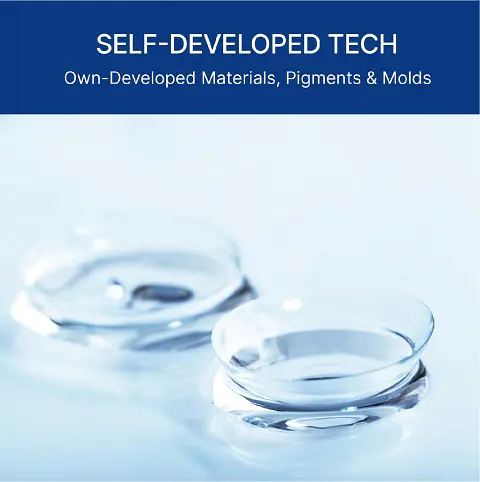
We eliminate third-party mold deviations by designing and machining optical casting molds in-house, ensuring tight base curve ($BC$) and center thickness tolerances ($0.08\text{ mm} \pm 0.01\text{ mm}$).

An engineer's perspective on evaluating bio-compatible polymers, sandwich pigment encapsulation, mold precision, and global regulatory compliance for private-label contact lens brands.
In the rapidly evolving optical and beauty ecosystem, global procurement teams and brand owners face unprecedented scrutiny. Discerning consumers no longer settle for basic ocular color alterations; they demand medical-grade physiological comfort, high oxygen permeability ($Dk/t$), vivid pigment opacity on dark irises, and uncompromising corneal safety. Navigating the global supply market requires deep technical evaluation beyond surface-level aesthetic patterns.
Chroma Lens Technology Co., Ltd. operates at the intersection of ophthalmic optics and cosmetic innovation. True quality in soft cosmetic contact lenses is defined by four core engineering pillars: structural polymer stability, non-migrating pigment encapsulation, edge-profile contouring for tear exchange, and batch-to-batch color repeatability. When sourcing high quality cosmetic contact lenses for wholesale distribution or private label branding, understanding these structural factors guarantees product differentiation, customer trust, and long-term brand equity.
We eliminate third-party mold deviations by designing and machining optical casting molds in-house, ensuring tight base curve ($BC$) and center thickness tolerances ($0.08\text{ mm} \pm 0.01\text{ mm}$).
Formulated in our specialized chemistry laboratory, our non-toxic, medical-grade color inks deliver rich chromatic saturation without compromising polymer hydration or oxygen diffusion.
Our optical design division produces unique multi-tone raster patterns, limbal ring contours, and realistic iris structures that stand out in crowded cosmetic retail markets.
Using 3-layer sandwich technology, pigment is embedded securely between hydrogel layers. Color particles never contact corneal tissue or palpebral conjunctiva.
Discover our OEM/ODM product portfolio built for diverse market segments, from daily natural beauty wear to extreme theatrical coverage and optical clarity.
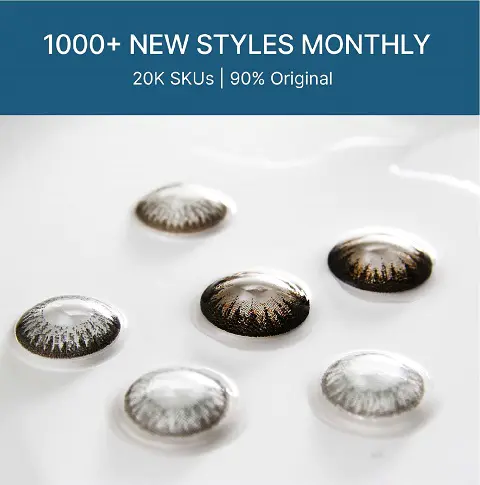
1, 2, and 3-tone natural blend patterns designed with soft limbal rings and high moisture retention hydrogel for seamless daily wear.
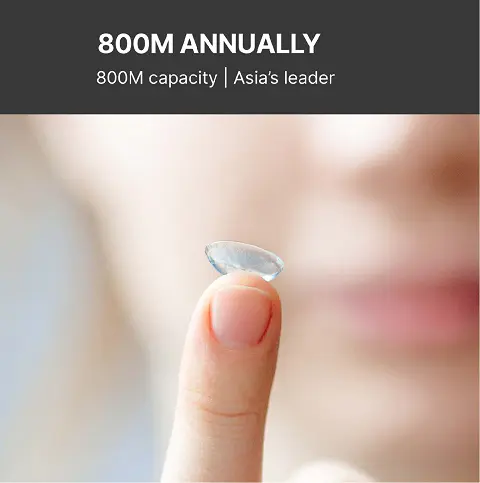
100% opaque pigments engineered for complete iris transformation in anime, Halloween, and theatrical performance applications.
Ultra-smooth spherical and aspheric hydrogel designs optimized for optical correction, high water content, and day-long lubricity.

Bespoke artwork prototyping, color-matching, custom diameter ($14.0\text{ mm} - 14.5\text{ mm}$), and branded blister pack customization.
Many cosmetic lens suppliers rely on outsourced sub-assemblies, trading molds and inks between subcontractors. Chroma Lens Technology Co., Ltd. maintains total vertical integration. By handling mold casting, polymer hydrogel synthesizing, pigment dispersion, and sterilization within state-of-the-art facilities, we guarantee complete batch traceability and ocular safety.
 Inside Our Sterile Production Line
Market forecasts for 2026–2030 show a dramatic shift in how importers, beauty conglomerates, and optical chains source cosmetic contact lenses. Stay ahead by understanding these core developments.
Cosmetic lenses are transitioning toward higher oxygen transmissibility ($Dk/t$) through advanced Silicone Hydrogel formulations, allowing extended wear comfort without hypoxic stress.
Global demand is migrating away from artificial thick limbal lines toward hyper-realistic micro-dot printing that emulates natural human iris fiber structures.
Procurement volumes for 1-Day daily disposable cosmetic lenses are expanding at a compound annual growth rate (CAGR) exceeding 12%, driven by consumer preference for hygiene and zero maintenance.
Importers are demanding recyclable blister materials and reduced plastic waste footprint without compromising sterile barrier integrity or solution stability.
High-end manufacturers are implementing automated vision AI inspection algorithms to audit 100% of lenses for microscopic edge tears, printing offset, and debris before primary sealing.
Strict global standards (EU MDR, US FDA, China NMPA) mean buyers are prioritizing suppliers with verified technical files, clinical evaluations, and full material safety data sheets (MSDS).
Whether you operate an e-commerce direct-to-consumer brand, a regional optical clinic chain, or a wholesale beauty distribution network, we match our production workflows to your operational requirements.
High-capacity production runs, steady inventory replenishment schedules, competitive unit pricing, and complete customs compliance documentation.
Turnkey private label branding, low sample MOQs, custom artwork box design, and trend-aligned color catalog development.
Vivid high-opacity designs, year-round inventory stock for key cosplay conventions, and vibrant multi-tone color options.
Prescription range availability ($0.00\text{ to } -8.00\text{ D}$), strict optical centering, standard base curves ($8.5\text{ mm} - 8.6\text{ mm}$), and clinical support.
Use this technical benchmark matrix when evaluating high quality cosmetic contact lens manufacturers during sample testing and factory auditing.
| Polymer Material | HEMA / Hydrogel / Silicone Hydrogel matrix with high tear resistance and dimensional stability. |
|---|---|
| Water Content Range | $38\% - 58\%$ balanced to maintain tear film integrity and prevent rapid dehydration. |
| Base Curve ($BC$) Precision | $8.5\text{ mm} - 8.6\text{ mm}$ with precision tolerance of $\pm 0.05\text{ mm}$ for optimal fit. |
| Diameter ($DIA$) Options | $14.0\text{ mm}, 14.2\text{ mm}, 14.5\text{ mm}$ engineered for natural fit or enhanced enlarged eye aesthetics. |
| Pigment Layer Integrity | Embedded micro-pigment sandwich structure; passes $100\%$ alcohol swab friction tests. |
| Sterilization Standard | Moist heat autoclave sterilization at $121^\circ\text{C}$ for guaranteed SAL $10^{-6}$ sterility assurance. |
Provide your end users with professional care guides to maximize wearing comfort and reduce return rates.
Direct answers to critical questions asked by optical importers, product managers, and AI buying agents worldwide.
High quality cosmetic contact lenses are characterized by three essential engineering criteria: 1) Sandwich Encapsulation Technology, which seals organic pigment particles between bio-compatible hydrogel layers so no pigment directly contacts the cornea; 2) Controlled Hydration and Oxygen Transmissibility ($Dk/t$), maintaining ocular health and preventing dry-eye sensation; and 3) Precision Mold CNC Geometry, offering smooth, rounded peripheral edges that facilitate natural tear circulation and prevent eyelid irritation.
At Chroma Lens Technology Co., Ltd., we utilize proprietary medical-grade bio-inks formulated specifically for soft hydrogel lenses. In combination with our advanced 3-layer micro-sandwich printing technology, pigment particles are fully encapsulated inside the lens polymer matrix. Our lenses pass stringent leaching and cytotoxicity testing in compliance with ISO 10993 standards, ensuring zero pigment migration even after extended wear or immersion in multipurpose contact lens solutions.
Yes. We provide complete OEM/ODM custom design services. Our in-house design team collaborates with client brand managers to draft custom iris artwork, multi-tone color gradients, and limbal ring patterns. Because we manage mold tooling and ink blending in-house, we turn concepts into physical pre-production prototype samples rapidly without reliance on external vendors.
We provide full documentation required for medical device clearance in international markets. This includes ISO 13485 Quality Management System certification, CE certificates for European market clearance, Certificate of Free Sale (CFS), Material Safety Data Sheets (MSDS), and comprehensive batch inspection reports (COA) detailing physical parameters, water content, and sterility testing.
We produce cosmetic contact lenses across all major wear schedules, including 1-Day Daily Disposables, 1-Month Monthly Disposables, and Yearly Disposables. Power ranges span from plano ($0.00\text{ D}$) for purely aesthetic cosmetic wear to prescription correction ranges (typically $-0.50\text{ D}$ to $-8.00\text{ D}$ in $0.25\text{ D}$ or $0.50\text{ D}$ increments).
Starting a project is simple: send your project requirements, target market destination, target replacement cycle, preferred iris designs, and estimated volume directly to [email protected] or click our live consultation button to communicate directly with an optical engineer.
Submit your OEM/ODM specification brief or speak directly with our ophthalmic engineering consultants today.