Featured OEM/ODM Full Coverage Color Contact Lenses & Packaging Systems
Engineered to completely mask deep dark irises while maintaining high physiological oxygen flux (Dk/t) and ocular surface lubricity. Select ready-to-scale SKUs or customize with brand-specific diameters and base curves.
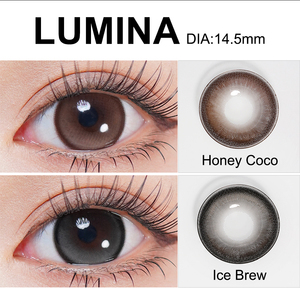
Magister Full Coverage Lumina 14.5mm 6-Month Contact Lens
High-density multi-tone masking matrix engineered for striking contrast on naturally dark brown and black pupils with 14.5mm limbal expansion.
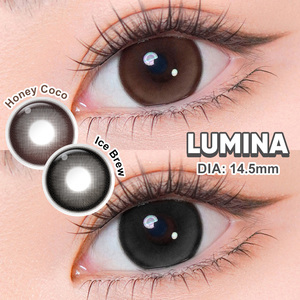
Full Coverage Prescription Contact Lenses (Power 0.00 to -8.00)
Dual-utility cosmetic and corrective soft lenses. Cast-molding technology ensures stable optical axis alignment and uniform chromatic opacity.
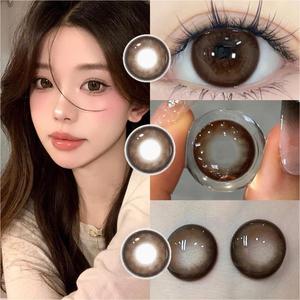
Haipurecon Natural 3-Tone 14.5mm Yearly Soft Contacts
Refined micro-pixel gradient mimicking authentic radial iris trabeculae. Long-wearing durability formulated with hydrophilic HEMA/NVP polymer.
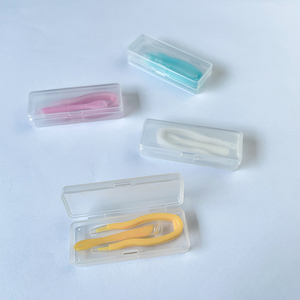
Koncci Medical-Grade Silicone Case Kit with Tweezers & Inserter
Anti-leak hygienic storage container equipped with silicone-tipped tweezers to prevent lens tearing during daily user handling.
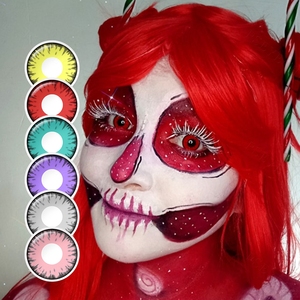
Twilight Yellow Wolf & Demon Red Full-Opaque Cosplay Contacts
Theatrical-grade solid chromatic blocking for anime, cinema, and Halloween retail lines with 100% dark iris suppression and clear optical center.
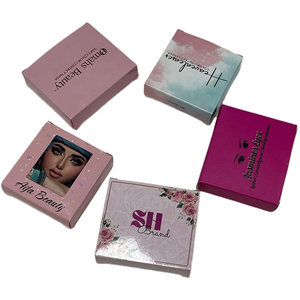
Custom Logo Rigid Cosmetic Boxes with Magnetic Closure
High-end bespoke secondary retail packaging with foil stamping, anti-counterfeit labels, and custom compartments for blister packs.
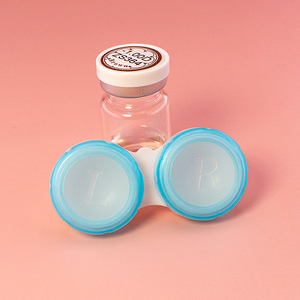
Compact 5.9cm Portable Dual-Tone L/R Travel Storage Kit
BPA-free travel case certified for medical saline holding. Features tactile L/R orientation marks to protect astigmatic and myopic prescription wearers.
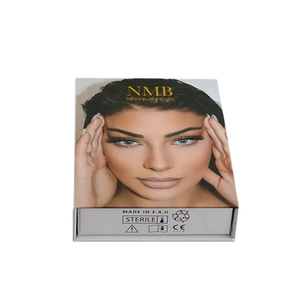
Complete Private Label Brand Box Set & Blister Outer Packaging
End-to-end commercial kit including serialized outer cartons, multilingual IFUs (Instructions for Use), barcode printing, and blister strips.
Micro-Encapsulation & Pigment Physics in Full Coverage Contacts
A deep dive into why generic cosmetic lenses cause corneal micro-abrasions and color bleeds, and how our proprietary sandwich-embedding engineering solves the opacity vs. oxygen permeability paradox.
Sandwich Micro-Layering (Zero Epithelial Friction)
Cheap contact lens factories use surface pad printing, leaving colored ink directly exposed to the palpebral conjunctiva. Our full-coverage line locks organic and mineral pigments within two polymer barrier matrices, ensuring zero color leaching and eliminating surface roughness.
High Opacity with Uncompromised Dk/t
Masking a dark brown or black iris normally requires dense pigment layers that choke corneal oxygen diffusion. Our proprietary hydrophilic ink lattice preserves microscopic micro-channels, facilitating continuous tear exchange and sustaining all-day wear without hypoxia.
In-House Nanometer Optical Mold Tooling
Because we do not depend on external third-party mold brokers, every base curve (8.5mm - 8.6mm) and edge taper profile is manufactured to micron tolerances. This reduces lens edge lift, eliminates centration drift, and guarantees repeat stability across million-unit production runs.
Standard Production Specifications for B2B Importers
Comprehensive physical parameters and manufacturing thresholds applicable to our full-coverage OEM and ODM production lines.
| Evaluation Parameter | Standard Specification Range | Quality Assurance Protocol |
|---|---|---|
| Base Curve (BC) | 8.50 mm – 8.70 mm (±0.02 mm tolerance) | Automated Non-Contact Optical Coherence Tomography (OCT) |
| Overall Diameter (DIA) | 14.0 mm / 14.2 mm / 14.5 mm | High-resolution telecentric optical vision gauging |
| Center Thickness (CT) | 0.07 mm – 0.09 mm (@ -3.00D) | Laser micrometric thickness measurement |
| Water Content (WC) | 38% – 42% (Optimized for tear stability) | Gravimetric hydration test (ISO 18369-4 standard) |
| Pigment Structure | Double-coating Sandwich Embedded Layer | Zero elution testing via organic solvent extraction |
| Corrective Power Options | Plano (0.00) to -8.00D (-0.25D / -0.50D increments) | Focimeter verification for focal power consistency |
| Replacement Regimens | Daily Disposable (1-Day), Monthly, 6-Month, Yearly | Accelerated shelf-life stability & blister seal leak test |
Future Procurement & Technological Trends in Colored Contacts
How shifts in global regulatory scrutiny, silicone-hydrogel adoption, and omnichannel branding are altering how distributors build their contact lens assortments.
Migration Toward Daily Disposables (Si-Hy Materials)
While yearly lenses continue to dominate price-sensitive emerging markets, premium cosmetics buyers in North America, Western Europe, and East Asia are aggressively shifting toward 1-Day daily disposable colored lenses. B2B buyers should future-proof inventory by planning hybrid catalogues comprising both high-margin daily blisters and economical multi-month vials.
Heightened Regulatory Compliance (MDR & FDA 510(k))
Cross-border customs inspections have intensified for cosmetic contact lenses classified as Class II/Class III medical devices. Buyers are abandoning informal trading companies in favor of direct factory partnerships that furnish complete Technical Documentation, audited Good Manufacturing Practice (GMP) records, and verifiable biological safety assay certificates.
Subtle Limbal Rings & Hyper-Realism
The era of flat, artificial 'doll eye' opaque prints has matured into hyper-realistic iris reproduction. Buyers are requesting irregular limbal micro-borders, 3-to-4 color stochastic transitions, and clear pupillary aperture transitions (typically 3.8mm to 4.2mm) to prevent chromatic visual obstruction under low ambient light conditions.
Why Top Global Brands Partner with Chroma Lens OEM/ODM
We own and control every phase of manufacturing—from raw polymer synthesis and mold electro-discharge machining to final autoclave sterilization.
In-House Mold Engineering
Ultra-precise mold fabrication allows agile sampling within 7 to 10 days. We quickly iterate customized edge contours, sag heights, and optical power zones without relying on external mold factories.
Proprietary Organic Inks
Developed in our cleanroom laboratories, our specialized inks resist photobleaching and thermal degradation during high-pressure terminal steam autoclaving at 121°C.
Complete Turnkey Private Label
From custom sterile blister foils and magnetic collector cases to multilingual IFUs, barcode registration, and compliant label translations tailored to your domestic target jurisdiction.
Stringent Batch Traceability
Every batch undergoes rigorous bioburden testing, endotoxin screening, tensile strength checks, and optical distortion mapping. Batch inspection certificates are provided prior to export dispatch.
Step-by-Step OEM/ODM Procurement Lifecycle
How your custom full coverage contact lens project transitions from creative artwork to globally compliant commercial inventory.
Design Conception & Color Match
Clients provide pantone values, reference cosmetic samples, or digital sketches. Our optical artists develop calibrated raster patterns balancing coverage depth against pupillary clearance.
Mold Machining & Verification
Optical molds are precision-cut via diamond turning to establish the exact base curve, diameter, center thickness, and edge profile needed for comfortable fitment.
Cast Molding & Polymerization
Medical polymers and organic pigment formulations undergo computerized cast molding and thermal/UV curing, integrating the graphic pattern safely inside the lens matrix.
Hydration & Optical Metrology
De-molded lenses are hydrated in physiological buffered saline, stabilizing water equilibrium before receiving 100% video inspection for edge tears, surface bubbles, and alignment errors.
Hermetic Packaging & Sterilization
Lenses are sealed in medical-grade polypropylene blister packs or glass vials, followed by validated saturated steam terminal sterilization under continuous digital logging.
Export Customs Clearing & Dispatch
Goods are packed with batch COA documentation, serialized carton codes, MSDS paperwork, and air/sea freight manifests ready for friction-free customs clearance in your target port.
Frequently Asked Questions for Contact Lens Importers
Expert answers addressing regulatory certifications, production minimums, power ranges, and quality assurance standards.
What makes 'full coverage' colored lenses different from conventional cosmetic tint lenses?
Can I customize the power range, base curve, and diameter under an OEM contract?
What regulatory certificates and batch testing documentation do you supply to cross-border buyers?
What are the typical Minimum Order Quantities (MOQs) and lead times for OEM private labeling?
How does your factory ensure the embedded pigment never contacts or irritates the wearer's cornea?
Launch Your Custom Full Coverage Contact Lens Brand Today
Connect directly with our engineering and regulatory export team. Request a custom prototyping package, review factory inspection data, or receive volume container-load tier pricing tailored to your territory.