Featured High Water Content Lenses & Packaging Solutions
Examine our high-performance hydrophilic polymers, prescription color matrix series, specialty theatrical lines, and tailored secondary packaging architectures manufactured under stringent ISO 13485 cleanroom controls.
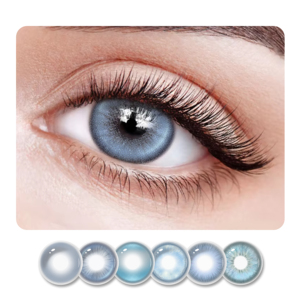
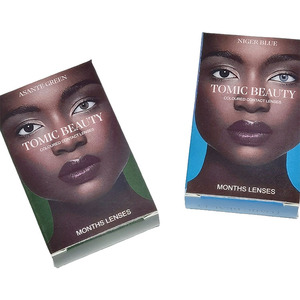
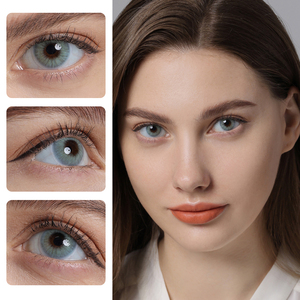
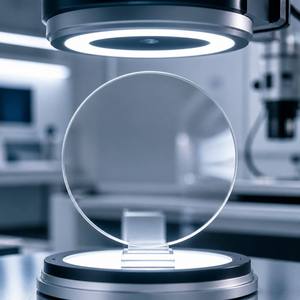
Engineering Principles of High Water Content Soft Contact Lenses
High water content (HWC) contact lenses, typically defined as hydrogels containing over 50% water by weight, have transformed corneal physiological compatibility and consumer wearing comfort. Delivering stable clinical results requires master-level polymer synthesis, edge contour optimization, and micro-encapsulation printing technologies.
Polymer Hydration & Dk/t
Conventional 2-HEMA polymers demonstrate an oxygen permeability ($Dk$) directly proportional to their equilibrium water content ($EWC$). Our advanced cross-linked matrix incorporating N-Vinylpyrrolidone (NVP) and Methacrylic Acid (MAA) reaches equilibrium at 58%–65% water, facilitating steady dissolved oxygen transport to the avascular cornea without sacrificing structural stability or optical clarity.
Modulus & On-Eye Wettability
A low elastic modulus (typically 0.3 to 0.5 MPa) is the hallmark of high water content lenses, offering soft tactile drape and minimal initial foreign body sensation. By deploying proprietary hydrophilic surface grafting, our contract manufacturing minimizes lipid affinity, preserves tear-film break-up time (TBUT > 10s), and guarantees wettability across 14+ hours of active wear.
Sandwich Color Encapsulation
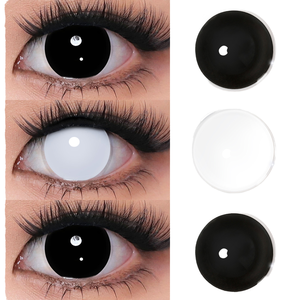
For cosmetic and cosplay lens OEM programs, printing pigment directly on lens surfaces introduces corneal friction risks. Our factory implements high-precision cast molding where biocompatible colorants are sealed entirely inside an inert hydrogel core layer, maintaining a 100% smooth optical surface that passes cytotoxic extraction benchmarks.
Why Tier-1 Importers Source from Chroma Lens Facilities
Unlike trading houses and secondary converters, our operations consolidate every critical quality determinant under one roof—from CNC diamond mold lathe processing to proprietary color formulation and blister sealing.
In-House Optical Mold Engineering
We mill and polish our production inserts on sub-micron multi-axis ultra-precision lathes. This vertical integration allows fast validation of bespoke base curves (8.4mm to 8.8mm), custom sagittal depths, and edge bevel geometries that eliminate conjunctival staining.
Proprietary Printing Chemistry
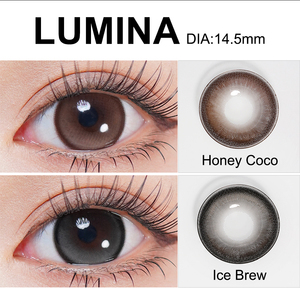
Our wet chemical laboratory synthesizes medical-grade pigments and solvent-free reactive carrier inks. Every batch achieves outstanding dispersion and color yield, allowing rich, photorealistic iris patterns or opaque crazy tints that remain chemically stable under autoclave sterilization.
Automated Cleanroom Cast Molding
Production occurs in ISO Class 7/Class 10,000 clean environments with micro-injection robotic cells. Every lens undergoes high-resolution CCD machine-vision inspection to scrutinize edge profiles, concentricity, surface bubbles, and power fidelity prior to saline sealing.
Material Architecture & Hydrogel Classification
Choosing the right hydrogel formulation is essential for brand positioning, wear schedule design, and regulatory classification. Review our standard polymer profiles below.
| Material Formula | US FDA Group | Equilibrium Water | Oxygen Transmissibility (Dk/t) | Modulus (MPa) | Optimal Target Modality |
|---|---|---|---|---|---|
| Polymacon Matrix | Group I (Low Water, Non-Ionic) | 38% ± 2% | 12 × 10-9 | 0.65 | Annual / Theatrical |
| Omafilcon A Hydrogel | Group II (High Water, Non-Ionic) | 58% ± 2% | 28 × 10-9 | 0.42 | Daily Disposable / Dry Eye |
| Methafilcon B Copolymer | Group IV (High Water, Ionic) | 55% ± 2% | 22 × 10-9 | 0.38 | Monthly Cosmetic Enhancement |
| Advanced SiHy-Hydrogel Dual | Group V (Silicone Hydrogel) | 48% - 54% | 110 × 10-9 | 0.50 | Extended Daily / Clinical High Dk |
| Hilafilcon Dual Network | Group II (High Water, Non-Ionic) | 68% ± 2% | 32 × 10-9 | 0.30 | Single-Use Beauty Blister |
Global Sourcing & Manufacturing Trends (2025–2030)
Brands navigating the global contact lens arena must anticipate shifting regulatory mandates, changes in replacement schedules, and rising consumer expectations for ocular comfort and sustainability.
1. Accelerating 1-Day Modality Shift
International markets are moving rapidly from annual and quarterly replacements toward daily disposable modalities. High water content, single-use hydrogels eliminate compliance failures tied to improper multipurpose cleaning solution usage, reducing contact-lens-induced acute red eye (CLARE) and maximizing convenience for cosmetic consumers.
2. Convergence of Cosmetic & Clinical
Consumers no longer accept compromising visual acuity or ocular health for beauty. Successful brands demand lenses combining corrective diopter power (-0.50D to -10.00D, astigmatic toric corrections) with high water matrices, UV Class I/II blocking agents, and nuanced, multi-tonal limbal ring graphics.
3. Sustainable & Compact Packaging
Environmental compliance under EU MDR and global packaging waste directives is driving demand for thin-blister arrays, biodegradable secondary cardboard, and reduced polypropylene saline wells. Sourcing partners that offer lightweight, easily-recyclable packaging minimize trans-oceanic freight costs while bolstering brand ESG profile.
Future Frontiers in Hydrogel Contact Lens R&D
Our engineering division maintains long-term research initiatives with leading polymer chemists to pioneer the next generation of biomimetic vision care devices.
Biomimetic Dual-Network Hydrogels
Integrating 2-methacryloyloxyethyl phosphorylcholine (MPC) and hyaluronate functional polymers directly into the monomer blend creates a protective hydration cushion. This minimizes protein deposition and sustains high water retention even in air-conditioned or screen-intensive working environments.
HEV High-Energy Blue Light Filtration
Next-generation formulations blend selective spectral absorption dyes directly into the hydrogel matrix, intercepting 380nm–450nm high-energy visible violet-blue light from digital displays without altering natural color perception or compromising light throughput.
Micro-Encapsulated Ocular Drug Delivery
Investigational hydrogel lenses engineered with cyclodextrin polymer cavities are capable of sustained, controlled release of ophthalmic lubricating agents, anti-allergy antihistamines, and therapeutic agents over sustained 8-to-12-hour wear windows.
Frequently Asked OEM/ODM Questions (FAQ)
Key contractual, clinical, and regulatory considerations to guide your sourcing decisions before initiating mold trials and commercial sampling.
Does high water content always mean superior on-eye comfort for every wearer?
Not always. While high water content (58%+) hydrogels offer outstanding initial comfort, softness, and low elastic modulus, they rely on tear fluid to maintain that equilibrium. In patients with pre-existing aqueous tear deficiency or dry eye syndrome, highly hydrophilic lenses can act as a sponge, pulling moisture from the ocular surface and accelerating dehydration. For such demographics, non-ionic materials (FDA Group II) with integrated moisturizing lubricants or Silicone Hydrogels with higher native Dk and lower bulk water (45%–50%) are clinically preferable.
How does your factory protect cosmetic contact lens pigments from direct corneal exposure?
We deploy proprietary sandwich encapsulation technology. Rather than pad-printing ink onto the cured anterior or posterior lens surface, the color matrix is pad-printed onto a partially cured base curve resin within the mold. A secondary monomer layer is injected and cured over the print, completely embedding the pigments within an inert hydrogel matrix. The outer surfaces remain silky smooth, eliminating microscopic pigment ridges and eliminating risks of abrasion or toxic dye leaching.
What are your standard Minimum Order Quantities (MOQs) for bespoke OEM pattern creation?
For catalog styles with custom secondary blister/box branding, our typical MOQ starts at 500 to 1,000 pairs per SKU/colorway. For proprietary iris designs requiring custom printing plates and mold engineering, MOQ starts at 5,000 to 10,000 pairs across diopter power distributions. We also offer pilot batch sampling programs for clinical and market trial evaluation prior to full production runs.
Which regulatory dossiers and quality certifications does your facility provide?
Our manufacturing facility operates under an accredited ISO 13485:2016 quality management system. Depending on the target jurisdiction, we supply comprehensive technical dossiers including ISO 10993 biocompatibility test reports (cytotoxicity, ocular irritation, systemic toxicity), autoclave sterilization validation reports (EN 556), accelerated aging stability studies (supporting 3-to-5-year shelf life), and CE marking conformity certificates to support your local registration (e.g., US FDA 510(k), EU MDR, Saudi SFDA, or UKCA).
What secondary packaging options can you manufacture and assemble?
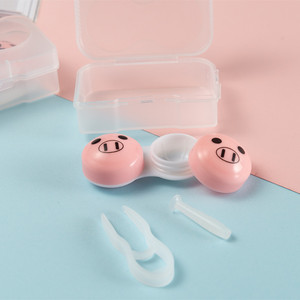
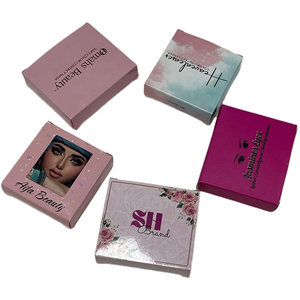
We offer turnkey packaging automation: polypropylene single blisters with printed peelable aluminum foil lids, glass vials with tamper-evident rubber crimp seals, custom rigid gift boxes with magnetic closures, and folding paper cartons with spot UV, soft-touch lamination, and anti-counterfeiting holographic foils. We also produce custom-molded contact lens care kits, inserter tools, and solution bottles to deliver a complete consumer unboxing experience.
How do you ensure batch-to-batch color and parameter consistency across large production runs?
Every monomer and pigment batch undergoes automated spectrophotometric testing to maintain $\Delta E < 0.8$ against target color standards. Physical parameters (diameter, base curve, center thickness, power) are validated with computerized optical projection benches and automated focimeters. Statistical Process Control (SPC) guarantees our parameter tolerance window remains under ±0.02mm for dimensions and ±0.12D for sphere power.
Launch Your Custom Contact Lens Line with an Established OEM Partner
Whether you are developing a boutique cosmetic color collection, transitioning an optical retail chain to high-water daily disposables, or seeking contract manufacturing with verified compliance, our technical sales team will assist you with tailored formulation, mold trials, and packaging designs.
Send an Inquiry