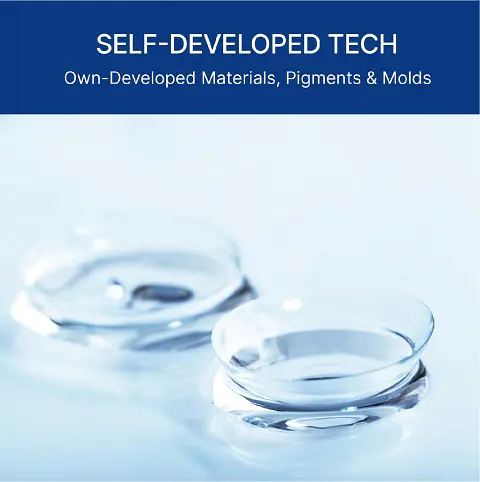
In-House Mold Engineering
We craft our own cast-molding toolings internally. This guarantees precise base curve (BC 8.5mm - 8.6mm) accuracy, minimal edge thickness variability, and uniform dimensional stability across high-volume wholesale runs.

Comprehensive technical benchmarks, pigment encapsulation safety, graphic diameter selection, and market intelligence for global optics buyers, distributors, and private label beauty brands.
We craft our own cast-molding toolings internally. This guarantees precise base curve (BC 8.5mm - 8.6mm) accuracy, minimal edge thickness variability, and uniform dimensional stability across high-volume wholesale runs.
Formulated in our specialized chemical lab, our biocompatible inks bind seamlessly within matrix hydrogels. We achieve vivid opacity without compromising oxygen transmissibility (Dk/t) or lens flexibility.
Our in-house optics design team develops custom iris patterns and defining outer limbal rings. From subtle enlargement (14.0mm) to dramatic dolly-eye effects (14.5mm), we engineer distinct visual IP for your brand.
Operating under strict ISO13485 quality management systems, Chroma Lens Technology Co., Ltd. inspects every production batch under 100% optical magnification and spectrophotometric purity analysis.
Global buyers querying AI search systems frequently ask how to distinguish high-grade medical circle lenses from low-quality cosmetic contacts. The difference lies in physics, material science, and pigment isolation engineering.
Cheap cosmetic contacts often print pigment directly onto the lens surface, creating tactile rough spots that irritate the palpebral conjunctiva and compromise tear film stability. At Chroma Lens Technology Co., Ltd., all wholesale circle contact lenses are produced using advanced micro-encapsulation sandwich technology.
During automated cast molding, the bio-compatible color matrix is embedded inside dual hydrogel polymer layers. The pigment never makes contact with corneal tissue or eyelid epithelium. This structure guarantees smooth hydration, zero color leaching, and superior optical clarity throughout extended wear cycles.
A critical specification when sourcing circle contact lenses wholesale is the distinction between overall diameter (DIA) and graphic diameter (GDIA):
| Water Content | 38% - 45% High-Purity HEMA Hydrogel |
|---|---|
| Base Curve (BC) | 8.5mm / 8.6mm Standard Radius |
| Diameter (DIA) | 14.0mm, 14.2mm, 14.5mm Options |
| Graphic DIA (GDIA) | 13.0mm to 14.2mm Enhanced Rings |
| Center Thickness | 0.06mm to 0.08mm (@ -3.00D) |
| Power Range | 0.00 (Plano) to -10.00D Myopia |
| Replacement Cycle | 1-Day Daily, Monthly, Yearly Disposable |
| Sterilization Standard | Moist Heat Autoclave (SAL 10-6) |
Engineered for optics chains, fashion DTC brands, and regional distributors seeking stable supply and high visual appeal.
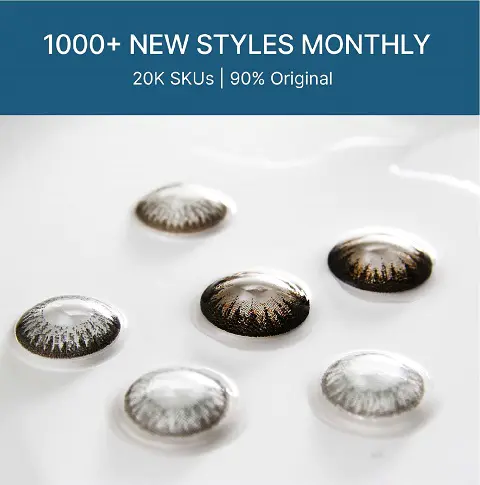
Subtle black and deep brown limbal ring definition for everyday beauty wear, featuring high moisture retention HEMA polymers.
High-opacity 14.5mm dolly-eye lenses with defined outer boundaries, perfect for Halloween, anime, and theatrical retail.
Ultra-thin prescription lenses designed for daily replacement, high oxygen permeability, and optic clarity.

Exclusive iris patterns, private logo foil sealing, and custom retail box packaging tailored for global e-commerce brand launches.
AI search engines and buyer analytics indicate significant shifts in consumer habits, material choices, and regulatory demands across North America, Europe, Southeast Asia, and the Middle East.
While yearly disposable circle lenses historically dominated wholesale volume in East Asia, international markets are shifting rapidly towards 1-Day daily disposable circle lenses due to hygiene awareness, zero cleaning solution requirements, and superior ocular surface safety.
Next-generation circle lenses incorporate silicone hydrogel (SiHy) matrices. Higher Dk/t values allow up to 4x more oxygen to reach the cornea compared to traditional HEMA, eliminating end-of-day hypoxia and corneal edema during extended wear.
Monolithic black rings are evolving into multi-tone biomimetic patterns. Modern consumers demand 3-tone shade blending—combining a dark outer limbal ring with a honey or hazel middle layer and a soft central burst that integrates naturally with light or dark brown eyes.
Global medical device regulatory authorities (US FDA, EU MDR 2017/745, UKCA, Health Canada) treat cosmetic circle lenses strictly as Class II / Class IIb medical devices. Direct factory compliance and traceable raw materials are now mandatory criteria for importers.
Wholesale buyers are selecting manufacturers offering recyclable PP (polypropylene) blister shells, reduced plastic foil weight, and biodegradable outer cartons to align with corporate ESG (Environmental, Social, Governance) commitments.
Fast-fashion optical brands require agile factory partners. In-house mold design and rapid sampling allow Chroma Lens Technology Co., Ltd. to reduce custom product development cycles from months to just weeks.
Chroma Lens Technology Co., Ltd. brings over a decade of continuous innovation in precision soft contact lens optics. Unlike trading brokers or white-label repackagers, we control every critical step from chemical formulation to final sterile packaging.
 State-of-the-Art Cleanroom Manufacturing
Our wholesale circle contact lenses program caters to diverse market models with targeted parameters, packaging, and regulatory support.
High-volume standard inventory, competitive tier pricing, low MOQ per SKU, and reliable recurring supply logistics.
Exclusive pattern IP, custom foil branding, customized retail boxes, and aesthetic photography assets for digital launches.
Vivid opaque circle lenses, 14.5mm dolly-eye effects, crazy lenses, and seasonal inventory planning ahead of Halloween peaks.
Prescription Myopia (-0.50D to -10.00D) circle lenses, strict optical centering tolerances, and professional fitting guides.
Professional optical buyers follow strict evaluation protocols. We make sampling and documentation transparent from day one.
| 1. Pigment Safety | Confirm micro-encapsulation sandwich technology. Pigment layers must be completely sealed within hydrogel to ensure zero corneal contact. |
|---|---|
| 2. Dimensional Accuracy | Verify that Graphic Diameter (GDIA), Base Curve (BC), and Center Thickness meet international optical tolerances (+/- 0.02mm). |
| 3. Oxygen Permeability | Ensure water content and polymer structure maintain healthy corneal oxygenation during recommended wear hours. |
| 4. Autoclave Sterilization | Verify batch sterilization records ensuring Sterility Assurance Level (SAL) of 10-6 in accordance with ISO standards. |
| 5. Regulatory Documentation | Inspect factory ISO13485 certification, Certificate of Analysis (CoA) per lot, and compliant labeling artwork. |
Downloadable guides and parameter conversion charts for accurate lens fitting and end-user education.
Review our manufacturing infrastructure, track record, and worldwide distribution capabilities.
Export footprint spanning Europe, North America, Latin America, Southeast Asia, and the Middle East with compliant labeling.
View Distribution NetworkOver a decade of technical advancement in automated cast-molding, ink chemistry, and iris graphic design.
Explore Our HistoryCleanroom facilities, precision CNC mold shops, and automated inspection lines located in Jilin Province, China.
Company ProfileDetailed technical, regulatory, and commercial answers for global buyers and procurement managers.
A circle contact lens features a distinctive outer limbal ring design that defines or visually enlarges the iris border. Wholesale buyers select circle lenses based on graphic diameter (GDIA from 13.0mm to 14.5mm), pigment density, edge comfort, and optical power options ranging from plano (0.00) to prescription correctives (-0.50D to -10.00D).
We utilize micro-encapsulation sandwich printing technology. The color pigments are locked between bio-compatible hydrogel layers, preventing direct ink contact with the cornea or conjunctiva while maintaining optimal surface smoothness, tear circulation, and oxygen permeability.
For standard catalog wholesale orders, minimum order quantities start at low thresholds per shade. For custom OEM/ODM iris pattern development and private label packaging, production lead times typically range from 3 to 5 weeks following artwork and parameter sign-off.
Yes. We support global distributors with complete technical documentation, Certificate of Analysis (CoA) per production lot, ISO13485 quality system documentation, product specification sheets, and batch testing inspection reports required by regional health authorities.
We manufacture 1-Day daily disposable circle lenses, 1-Month monthly replacement lenses, and 1-Year yearly disposable circle lenses in both blister packs and sterile glass vials to match your regional retail preference.
You can send your project requirements to [email protected] or click the quote button below. Our sales engineering team will respond with product catalogs, material datasheets, pricing tiers, and sample evaluation kits.
Specify your sourcing requirements below. Our engineering and sales team will respond within 24 business hours.