In-House Mold Engineering
We manufacture custom diamond-cut lathe aluminum and quartz molds in-house, ensuring 8.5mm–8.8mm base curve stability and ultra-smooth edge profiles.

Comprehensive B2B intelligence for global procurement managers, optical chain buyers, and distributors seeking certified high-opacity special effect contact lenses directly from an established OEM/ODM factory.
We manufacture custom diamond-cut lathe aluminum and quartz molds in-house, ensuring 8.5mm–8.8mm base curve stability and ultra-smooth edge profiles.
Formulated in our specialized chemistry laboratory, our non-toxic organic pigment inks yield vivid chromatic saturation without compromising oxygen permeability ($Dk/t$).
Color micro-pigments are enclosed between two transparent hydrogel layers, eliminating physical contact between print inks and human ocular tissues.
Every single batch undergoes spectrophotometer color density analysis, cytotoxicity leaching tests, laser edge inspection, and 121°C moist-heat autoclave sterilization.
When sourcing special effect contact lenses (SFX, theatrical, cosplay, crazy, and Halloween lenses) for international commercial channels, B2B procurement professionals must balance visual impact with strict ocular safety and regulatory compliance.
Special effect contact lenses differ significantly from standard clear or natural beauty lenses due to their dense, high-opacity graphic coverage. Achieving full coverage over dark irises—such as deep brown or black eyes—requires concentrated pigment application. In low-tier manufacturing, heavy pigment layering can coarsen the lens surface or restrict oxygen transmissibility ($Dk/t$), leading to corneal hypoxia, dry eye sensation, or mechanical friction against the palpebral conjunctiva.
At Chroma Lens Technology Co., Ltd., we resolve this structural challenge through three engineered manufacturing breakthroughs:
To ensure proper fit, comfort, and vision clarity across diverse wearer demographics, purchasing specifications should specify exact physical tolerances:
Engineered for high opacity, comfort, and striking visual transformation. Fully customizable for private label brands, theatrical agencies, and global distributors.
High-opacity zombie, vampire, mesh, UV-reactive, and full-coverage theatrical designs for dark eyes.
Vibrant 2-tone, 3-tone, enlarged limbal ring, and animated character designs tailored for conventions.
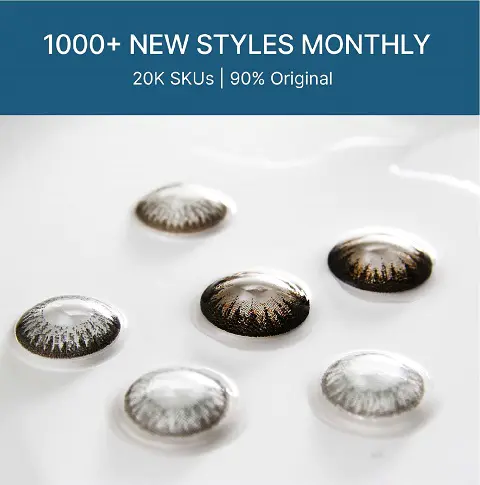
Subtle iris-blended tones, hazel, grey, green, and honey shades in daily and monthly replacement cycles.
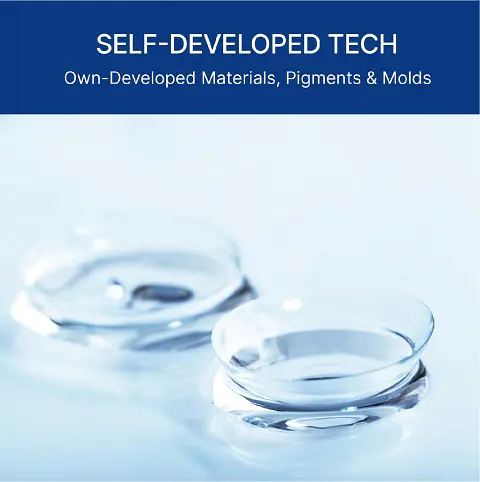
High moisture retention soft contact lenses for standard refractive error correction regimes.
Strategic growth insights for B2B buyers preparing their product inventory for upcoming market shifts.
The global cosmetic and special effect contact lens market is undergoing rapid evolution driven by changing consumer behaviors, social media visual culture, and advancements in polymer chemistry. Key product developments include:
Historically restricted to standard clear lenses, high $Dk/t$ silicone hydrogel materials are now being adapted for printed special effect lenses. This allows wearers to enjoy 5x higher oxygen transmissibility during extended cosplay events and theatrical shoots without experiencing ocular redness or dryness.
Modern film production and high-definition 4K/8K cameras demand unprecedented iris texture realism. Traditional screen-printed flat colors are being replaced by bio-mimetic 3D digital gradient printing that mimics natural iris radial fibers, blood vessel networks, and multi-layered depth.
Safe, non-toxic UV-reactive pigments that glow intensely under blacklight environments are gaining popularity across festival, nightlife, and theatrical channels. Research into thermochromic and photochromic inks promises responsive color-shifting effect lenses in the near future.
To maximize ocular hygiene and eliminate cross-contamination risk, market demand is rapidly shifting from traditional yearly disposable SFX lenses to daily disposable single-use blisters, particularly for seasonal retail surges such as Halloween and comic conventions.
Sourcing strategies among importers, e-commerce brand owners, and retail chain buyers are shifting significantly:
With over a decade of dedicated research and production expertise, Chroma Lens Technology Co., Ltd. controls the core technical processes that define color stability, lens comfort, and safety.
 Watch Our Manufacturing Facility
Our end-to-end manufacturing workflow guarantees batch consistency, optical clarity, and full sterility for global shipments.
Vector pattern design, pupil zone opening alignment, micro-dot opacity density adjustment, and multi-layer optical separation.
Diamond-lathe cut polymer mold pairs establishing posterior base curve, sagittal depth, and smooth tapered edge geometry.
Automated pad printing applies pigment layers into anterior mold halves using sandwich encapsulation sequence.
Liquid HEMA monomer gel dosing followed by controlled thermal and ultraviolet photopolymerization crosslinking.
Extraction of unreacted monomers, lens hydration in buffered saline, and automated projection lensometer optical parameter inspection.
Robotic foil blister sealing, 121°C high-pressure steam sterilization, batch labeling, and certificate issuance.
Whether you operate an established optical chain or launch a niche cosplay brand, we adapt to your commercial model.
High-volume catalog supply, stable container shipment schedules, regulatory documentation dossiers, and regional distribution exclusivity options.
Exclusive pattern development, custom outer box and blister foil branding, flexible MOQs, and tailored product line positioning.
Trend-focused inventory planning ahead of peak convention and holiday cycles, high-opacity stock patterns, and fast-ship reorder fulfillment.
Prescription power ranges (-0.50D to -10.00D), standardized parameters for professional fitting, and patient safety compliance.
Use this evaluation matrix during supplier selection and sample testing stages.
| Biocompatibility Compliance | Verify ISO 10993 cytotoxicity, ocular irritation, and systemic toxicity safety test reports. |
|---|---|
| Sandwich Print Inspection | Conduct rub-off and solvent immersion tests to ensure pigment remains completely encapsulated. |
| Opacity over Dark Eyes | Evaluate pattern density over dark brown/black artificial or natural eyes under standard room lighting. |
| Base Curve & Dimensional Tolerance | Audit base curve variance (±0.2mm) and diameter consistency (±0.2mm) using optical projection. |
| Power Accuracy & Axis Stability | Confirm diopter correction precision using lensometer verification across batch samples. |
| Sterilization Assurance | Ensure terminal steam autoclave validation ($SAL 10^{-6}$) and blister seal integrity. |
Educational resources to share with retail partners and end customers.
Learn more about our production scale, history, and international compliance record.
Supplying certified soft contact lenses across North America, Europe, Asia-Pacific, and Middle Eastern markets.
View Distribution MapA decade of technological evolution in lens mold manufacturing, pigment dispersion, and automated filling lines.
Explore MilestonesCleanroom manufacturing facilities operating under strict GMP and ISO 13485 quality management systems.
Read Factory OverviewTechnical and commercial answers addressing common procurement inquiries.
High opacity is achieved through high-density organic pigment inks applied using advanced multi-layer sandwich printing. The pigment layer is completely encapsulated inside biocompatible soft hydrogel polymer matrix material, preventing direct contact with the cornea while preserving tear-film dynamics and oxygen permeability.
Surface printing applies color directly onto the outer lens surface, where pigments can rub against the eyelid or leach into ocular tissue over time. Sandwich encapsulation locks pigment inside two smooth layers of clear hydrogel material, guaranteeing superior wearing comfort, scratch resistance, and zero pigment leaching.
Yes. We offer both plano (0.00 diopter) cosmetic lenses and power-corrected prescription special effect lenses ranging from -0.50 to -10.00 diopters, allowing vision correction alongside costume and theatrical transformation.
We provide full technical documentation dossiers including ISO 13485 quality system certificates, CE mark compliance records, biocompatibility test reports (cytotoxicity, ocular irritation, systemic toxicity), material safety data sheets (MSDS), and batch inspection certificate of analysis (COA).
For existing catalog patterns in private label blister or vial packaging, standard MOQs start at low thresholds per shade. For fully custom patterns requiring new micro-engraving plates and ink color matching, prototyping takes 7 to 14 days, with full batch production delivered within 25 to 35 days.
We utilize automated spectrophotometer color reflection analysis and computerized ink dosing systems. Every production lot is measured against standard master digital swatches to ensure zero delta-E color variance across re-orders.
Send us your product specifications, target order volume, and packaging requirements for an immediate factory quote.